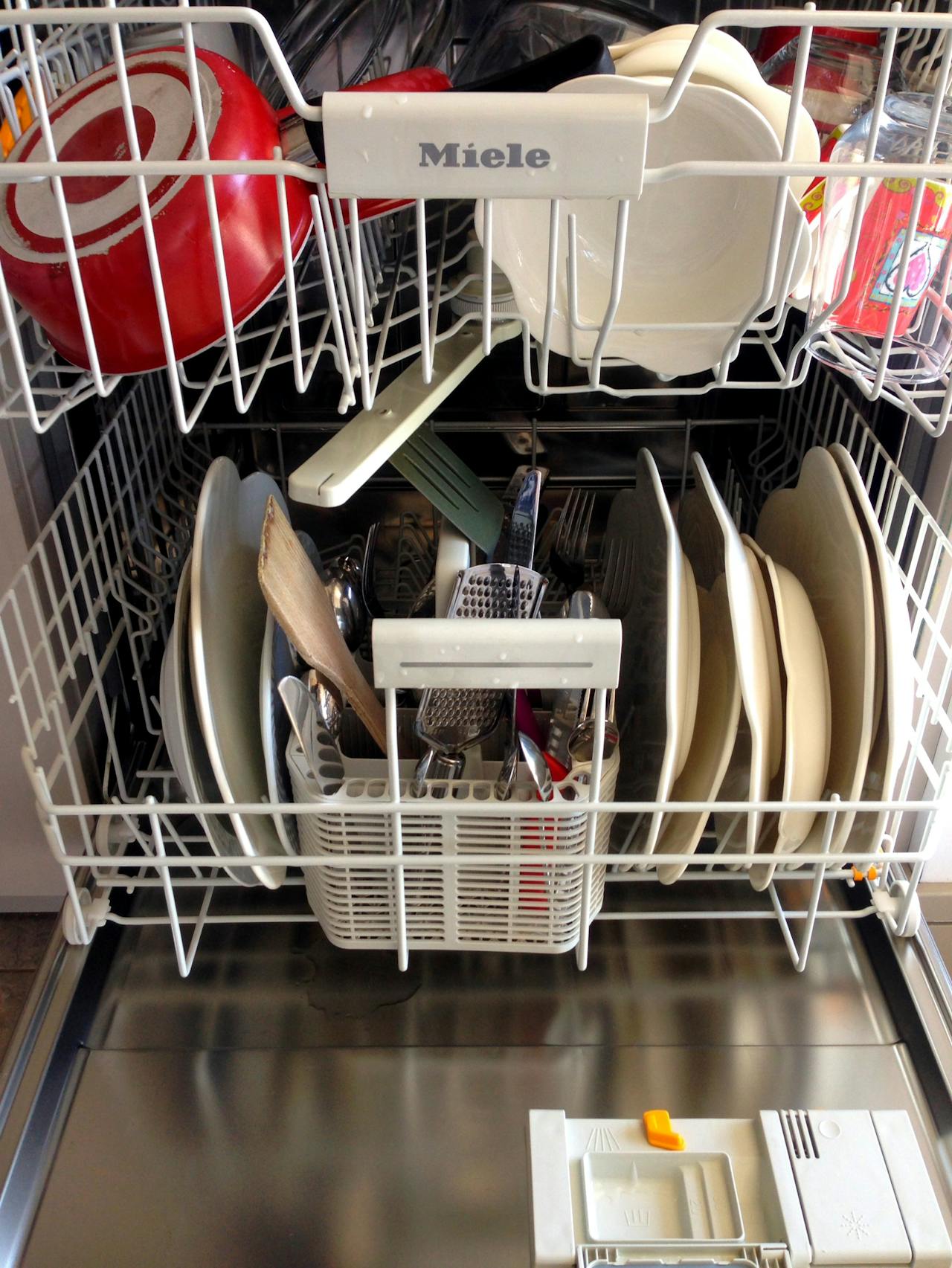
Hard Water in Encino and What It Does to Your Dishwasher
Every week I open up a dishwasher somewhere in Encino and find the same thing: white crust on the heating element, spray arm holes half-plugged with mineral, and a homeowner who’s been blaming the detergent.
It’s not the detergent. It’s the water.
Why Encino water is hard
LADWP supplies Encino with a blend, and a good chunk of it is San Fernando Valley groundwater. Groundwater picks up calcium and magnesium as it moves through rock, and by the time it reaches your kitchen, the Valley routinely runs 12 grains per gallon or more. For reference, anything above 10.5 grains is classified as “very hard.” Parts of the Westside get softer imported water. We don’t.
Twelve grains doesn’t sound like much until you do the math on a dishwasher. A typical cycle uses 3 to 5 gallons, heated to 120-140°F. Heat forces dissolved calcium out of solution, and it lands on the hottest surface in the machine, which is the heating element. Run one cycle a day and you’re baking mineral onto that element 365 times a year.
What scale actually breaks
Scale isn’t cosmetic. Here’s the failure sequence I see over and over:
The heating element works harder, then dies. A layer of calcium carbonate is an insulator. The element has to run longer to hit the same water temperature, which stresses it, and eventually it burns out or the high-limit thermostat starts tripping. Symptom: dishes come out wet and cool, or the cycle runs forever.
Spray arms clog and seize. The spray holes are small, some under 2mm. Mineral narrows them, the spray pattern collapses, and the top rack stops getting clean. Worse, scale works into the center bearing the arm spins on. I’ve pulled spray arms in 1960s and ’70s tract kitchens north of Ventura that barely rotated at all. The owner thought the pump was failing. It was a $40 spray arm.
The inlet valve gums up. This is the one nobody expects. The water inlet valve has a small screen and a rubber diaphragm, and hard water crusts both. A partially blocked valve fills slowly, so the machine washes with less water than it was designed for. A valve that won’t seal drips into the tub between cycles. Either way, it’s usually the valve, not the “computer.”
Racks rust early. Mineral deposits hold moisture against the nylon rack coating at the wire tips. Once it cracks, the wire rusts, and rust flecks end up on your dishes.
Cloudy glasses vs. etched glasses
This one matters, because the two problems look almost identical and have opposite causes.
Cloudiness from hard water is a mineral film sitting on the glass. Test it: soak the glass in white vinegar for five minutes. If it clears up, it’s mineral, and it’s reversible. That’s the classic Encino case.
Etching is permanent damage to the glass surface itself. It shows up as a faint rainbow haze or tiny pits, and vinegar does nothing. Etching happens when the water is too soft for the amount of detergent you’re using, or the detergent dose is too high. The wash chemistry literally eats the glass.
Why do I bother explaining this? Because homeowners who install a water softener often keep using the same heavy detergent dose they needed for hard water, and six months later they’ve traded cloudy glasses for etched ones. Softened water needs maybe half the detergent. Nobody tells people that.
Rinse aid isn’t optional here
In soft-water cities, rinse aid is a nice-to-have. At 12+ grains, it’s doing real work. Rinse aid breaks the surface tension so water sheets off instead of sitting in droplets, and every droplet that dries on a glass in Encino leaves its minerals behind. It also matters for drying: most machines built in the last decade use condensation drying rather than a heated dry cycle, and that design flat-out assumes rinse aid is in the dispenser.
Fill it. Set the dosage to 3 or 4 instead of the factory 2. It costs a few dollars a month and it’s the cheapest fix in this entire article.
Once a month, run an empty cycle with citric-acid descaler or two cups of white vinegar in a bowl on the top rack. That dissolves buildup on the element and the sump before it gets thick.
What a repair actually costs
Realistic numbers for the hard-water repairs we do around here:
- Water inlet valve: $150-$250 parts and labor. Most common hard-water repair we do.
- Spray arm or arm bearing: $90-$180.
- Heating element: $180-$300 depending on brand. Bosch and Miele integrate the element into the heat pump/sump assembly, which pushes it toward $350-$450.
- Descale and full service: $120-$160 if nothing’s broken yet.
A decent new dishwasher runs $700-$1,100 installed, more like $1,800-$2,800 for Bosch 800 series or Miele. So the 50% rule usually says repair. A 6-year-old machine with a $200 valve problem is an easy call. A 12-year-old builder-grade unit with a dead element, tired pump, and rusted racks is not worth $400. I’ll tell you that on site.
When a softener changes the math
If you’re in one of the Ventura Boulevard corridor condos, you probably can’t touch the building’s plumbing, and a whole-house softener is off the table. Your tools are rinse aid, monthly descaling, and detergent with strong chelating agents. That regimen honestly gets you 80% of the way.
In the hillside homes south of the Boulevard it’s a different conversation. Those houses tend to have bigger kitchens, higher-end machines, and owners planning to stay 15+ years. A whole-house softener runs $1,500-$3,000 installed. Spread across a Miele dishwasher, a Sub-Zero with an ice maker, a steam oven, and every faucet and shower valve in the house, it pays for itself. I’ve serviced softened-water dishwashers at year 14 that looked newer inside than unsoftened three-year-old machines.
And the older tract homes north of Ventura, the ’60s and ’70s kitchens off Hayvenhurst and White Oak? Many still have original galvanized supply lines, which shed their own mineral debris on top of what LADWP delivers. If your inlet screen keeps clogging, the pipes are part of the story.
The short version
Encino water will shorten your dishwasher’s life if you let it. Rinse aid on a high setting, a monthly descale, and correct detergent dosing will push most machines well past ten years even at 12 grains. And when something does fail, it’s usually a valve, an element, or a spray arm, all cheap enough to fix.
Dishwasher acting up, or glasses going cloudy no matter what you try? Call us at (818) 293-0141. We’re on Ventura Blvd and we work on this exact problem every single week.